
Kristal & Stone Guide
An educational material-selection and wholesale buying reference for natural crystal beauty tools, gemstone jewelry, carved stone decor and custom gifts.
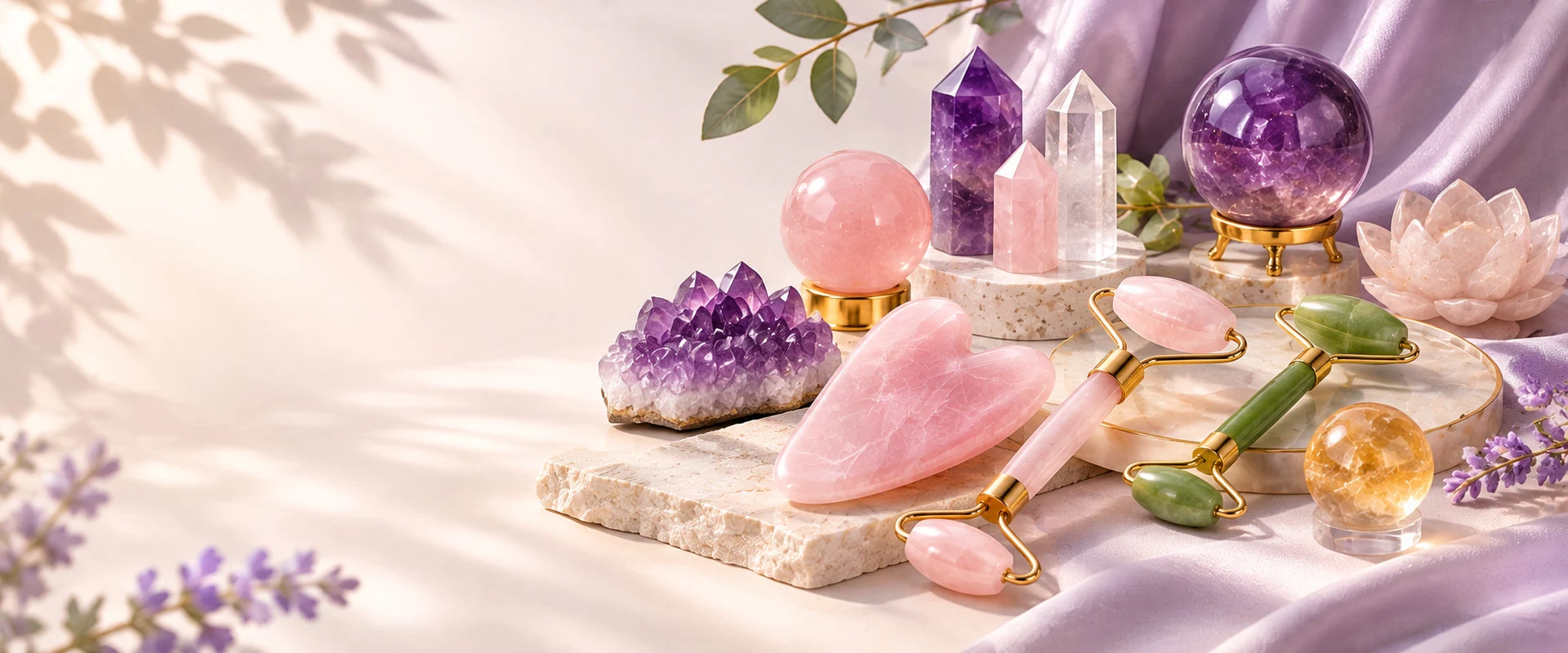
Natural crystals and stones are valued for their color, texture and workmanship—but no single material is suitable for every application. Use this guide to understand common stone types, manufacturing considerations and the key questions to ask when developing a wholesale collection.
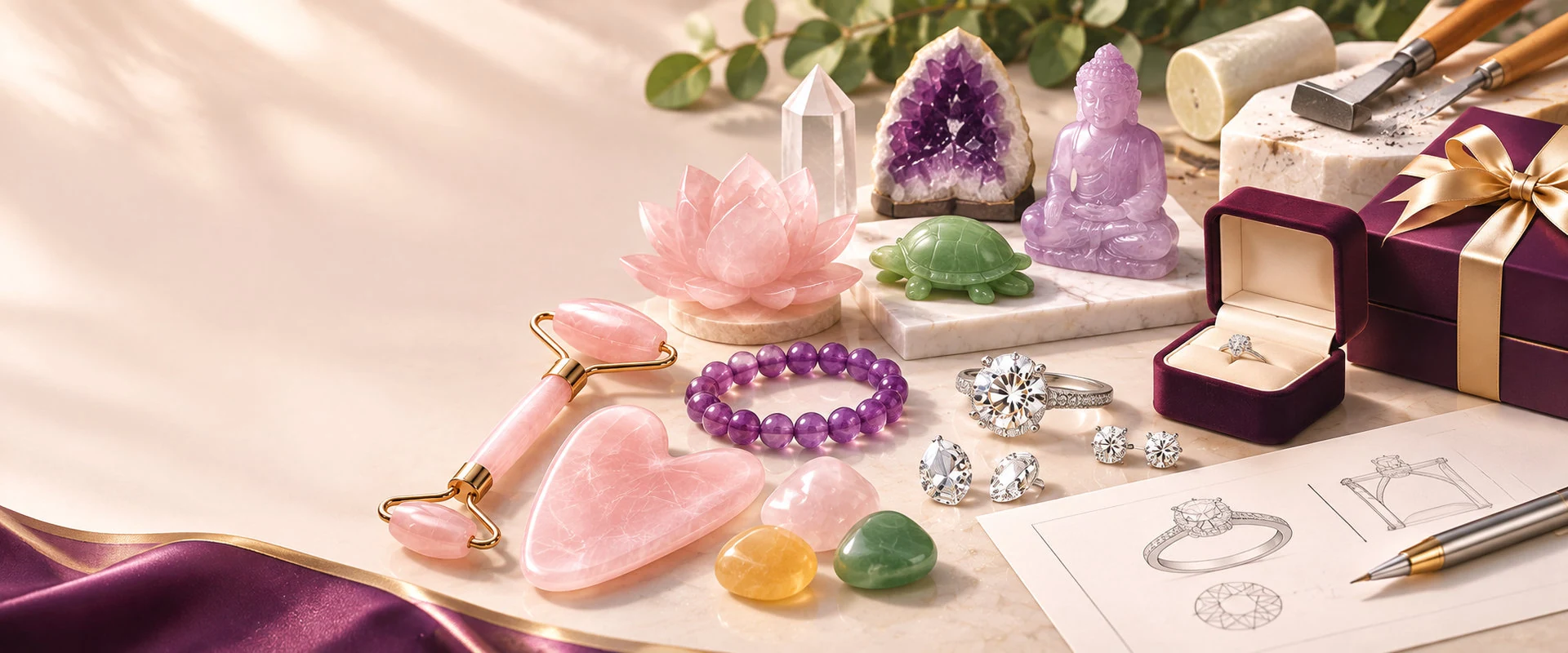
Illustrative product composition · Natural and synthetic materials should be identified individually.
What Are Natural Crystals & Stones?
A crystal is a solid with an ordered atomic structure. Quartz is a crystalline mineral; rose quartz, amethyst and clear quartz are varieties of quartz. In the gift and decoration trade, “natural stone” is a broader term that can cover minerals, rocks and naturally occurring glass.
Clear naming matters for quotations. Lapis lazuli is a rock composed of several minerals, obsidian is natural volcanic glass, and jadeite and nephrite are two distinct materials commonly sold as jade.
Separate category: Most moissanite sold for jewelry is laboratory-created silicon carbide. It should not be described as a natural quartz or crystal stone.
Popular Crystal & Stone Materials
Use this table to compare commonly requested stones. Mohs values are approximate and indicate scratch resistance rather than overall impact strength.
| Klip / materiaal | Identity | Mohs | Appearance | Typical applications |
|---|---|---|---|---|
| Rooskwarts | Quartz (SiO₂) | 7 | Pale to medium pink; often translucent | Gua sha, rollers, hearts, jewelry |
| Ametis | Quartz (SiO₂) | 7 | Violet to purple; natural color zoning | Clusters, towers, bracelets, beads |
| Helder kwarts | Quartz (SiO₂) | 7 | Colorless to milky, transparent to translucent | Points, spheres, displays, carvings |
| Jadeite / Nephrite | Different jade minerals | 6.5–7 / 6–6.5 | Green, white and additional colors | Gua sha, rollers, bangles, carvings |
| Agaat | Chalcedony (microcrystalline quartz) | 6.5–7 | Banded, striped or variegated patterns | Coasters, slices, beads, geskenke |
| Green Aventurine | Quartz-rich rock | ≈ 6.5–7 | Green, often with subtle shimmer | Rollers, beads, palm stones, decor |
| Tiger’s Eye | Quartz with chatoyancy | ≈ 7 | Golden-brown, shifting bands | Armbande, pendants, small gifts |
| Obsidiaan | Natural volcanic glass | ≈ 5–5.5 | Mostly black with glassy luster | Pendants and decorative objects |
| Fluoriet | Calcium fluoride (CaF₂) | 4 | Purple, green and multicolor | Display towers, spheres, carvings |
| Lapis Lazuli | Multi-mineral rock | 5–6 | Deep blue; often pyrite flecks | Beads, pendants, ornaments |
Natural Material Variation
- Rooskwarts: Pink tone, translucency and internal cloudiness may vary by batch.
- Ametis: Color zoning and different purple intensities can be natural features.
- Jade: Clarify jadeite versus nephrite and any resin treatment, dye or coating.
- Agaat: Banded patterns vary; dyed material is also sold commercially.
- Fluoriet: Attractive for display, but softer and more vulnerable during handling.
Hardness, Toughness & Durability
Mohs hardness measures the relative ability of minerals to resist scratching. It does not indicate whether a thin object or sharp corner will chip or break when dropped.
Hardness
How well does the surface resist marks from contact with harder objects?
Toughness
How well does the material resist impacts and the propagation of cracks?
Stability
How does the stone respond to temperature, light, water and chemicals?
For example, nephrite and jadeite are valued for good toughness even though some other gemstones have higher Mohs hardness. Choose a material based on shape, cost, finish and intended use—not Mohs ranking alone.
Choose Stone by Application
Skoonheid & Wellness Tools
For gua sha boards, face rollers and massage accessories, prioritize accurate material naming, comfortable rounded edges, smooth polish, appropriate thickness and consistent tolerances. Being natural does not imply a medically proven benefit.
Kristal juweliersware & Beads
Check color consistency, drilling, bead size, polish, mounting requirements and relevant stone treatments. Small products may need tighter shade matching than decorative geodes.
Huisversiering & Display Pieces
For spheres, towers, slices and carved pieces, consider base stability, sharp points, weight, natural inclusions, protection during shipment and surface finish.
Kristal geskenke & Private Label Sets
Define the visual story, product geometry, logo method, packaging inserts and expected repeatability. A protective, gift-ready package may be as important as the stone piece.
Stone Manufacturing & Finishing
A typical workflow includes rough stone selection, cutting, shaping, drilling or engraving, polishing, dimensional inspection and protective packaging. Actual methods depend on the mineral, product and workshop setup.
For an accurate quotation, send product images or drawings, stone selection, dimensions and tolerances, expected color variation, surface finish, order quantity and destination country.
Authenticity, Treatments & Quality Control
Color alone cannot confirm gemstone identity. Natural-looking inclusions are not proof. When material claims have commercial importance, request suitable identification records or independent gemological testing.
- Exact naming: Identify rose quartz, jadeite, nephrite, agate or other material precisely.
- Treatment disclosure: Identify known dyeing, heating, filling, resin impregnation and coating.
- Approved samples: Define acceptable variation in color, clarity, grain and veining.
- Physical inspection: Check chips, sharp edges, cracking, poor drilling and polish.
- Compliance: Evaluate requirements for skin-contact items, jewelry parts, children’s products and food-contact uses if relevant.
Cleaning, Care & Protective Packaging
Use a soft cloth for general cleaning and avoid harsh chemicals, sudden heat changes and dropping stones. Some untreated quartz and jade items may tolerate mild soapy water, but recommendations differ for each stone and treatment.
Exercise extra caution with softer, porous, fractured or coated stones. Do not assume all crystals can be immersed, steam-cleaned or cleaned ultrasonically. For face rollers, consider metal fittings and adhesives as well as the stone.
For export orders, evaluate protective sleeves, molded inserts, partitioned gift boxes, outer-carton strength and the different risks posed by towers, spheres and thin gua sha edges.
Buyer’s Specification Checklist
Use this brief to reduce sample revisions and avoid uncertainty in quotations.
- Product: Naam, intended application, drawing or reference photo.
- Materiaal: Exact stone name, treatment requirements and desired grade.
- Grootte: Length, width, dikte, hole dimensions and tolerances.
- Appearance: Color family, transparency, veining and inclusions.
- Voltooi: Polishing, edge rounding, engraving and hardware.
- Branding: Logo, cards, barcodes, labels and gift packaging.
- Quantity: Sample order, first production run and forecast.
- Destination: Country, packing and product-specific testing needs.
Kristal & Stone Buyer FAQ
What is the difference between a crystal and a natural stone?
A crystal has an ordered internal atomic structure. “Natural stone” is a broader trade term that may include minerals, rocks and naturally occurring glasses. Quartz is crystalline; lapis lazuli is a rock; obsidian is volcanic glass.
Is rose quartz better than jade for a gua sha tool?
Neither material is universally better. Rose quartz provides a pink appearance, while jadeite and nephrite provide different colors and particularly good toughness. Prioritize verified material identity, smooth edges, shape, finish and your intended market.
Does a higher Mohs hardness mean a product cannot break?
No. Mohs measures scratch resistance, not impact resistance. Thickness, inclusions, edge geometry and workmanship influence breakage risk.
Can natural crystal products vary in appearance?
Ja. Natural color, veining, inclusions and transparency vary. Approve reference samples and define acceptable variation before production.
How can wholesale buyers verify that stones are natural?
Request exact material naming, treatment disclosure and independent gemological testing when commercially necessary. Photographs alone cannot conclusively establish identity.
Can crystal products be customized with a logo?
Many items can be engraved, marked where suitable, or paired with branded packaging. Feasibility depends on the material, dimensions, finish and quantity.
Are all natural crystals safe for skin or food contact?
No. “Natural” is not proof of suitability. Evaluate surface finishing, applicable safety rules and any material or treatment-specific tests for the intended use.
Can I clean every stone in water or an ultrasonic cleaner?
No. Porous, soft, fractured or treated stones may be damaged. Follow care requirements for each material and for any metal components.
Do you have a fixed MOQ or lead time?
MOQ, samples and lead time depend on stone, product size, process, quantity and packaging. Send a specification or reference photograph for a project-specific quote.
Ready to Develop Your Crystal Products?
Tell us your stone preference, product reference, dimensions, quantity and packaging requirements. We will review feasible OEM/ODM options for your project.